
Backyard Drip Irrigation Installation: Easy Steps for Home Gardeners
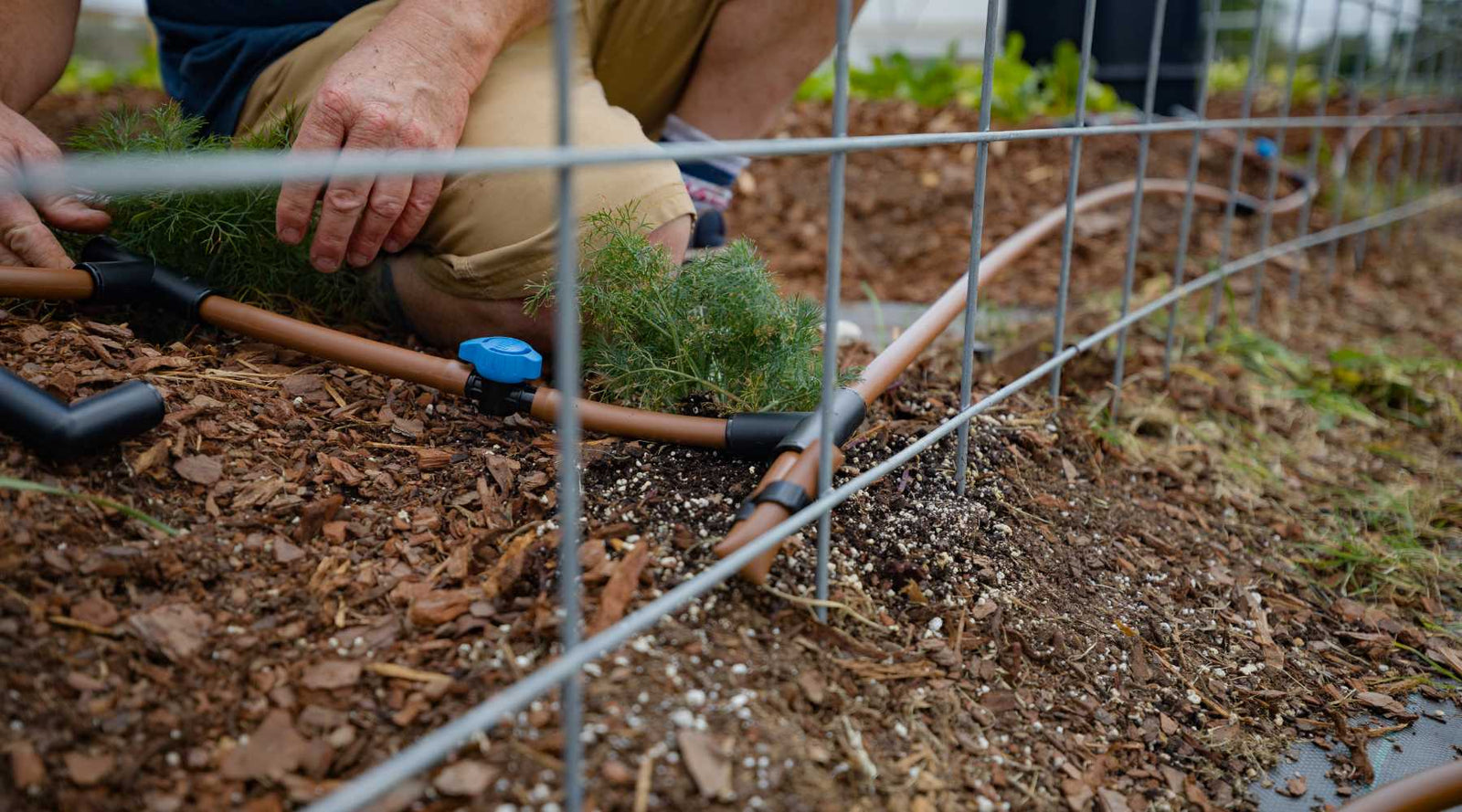

How to Install a Drip Irrigation System: A Beginner's Backyard Guide
You can plant the healthiest seedlings in the most balanced soil, but if you don’t water the garden consistently, they will not thrive. If you are wondering how to install a drip irrigation system, it may seem daunting at first, but it’s completely doable.
Overhead watering has its place and is helpful when plants need immediate cooling, but it is uneven and inefficient. Soaker hoses are simple and inexpensive, but can lead to waterlogging plants. Alternatively, drip irrigation systems reduce water waste, save time, allow growers to vacation with peace of mind, and keep plants healthy by getting water to their root systems.
Let us guide you through designing and installing a backyard drip irrigation system to help you save time, reduce labor, ensure healthy plants, and boost yields.

What is Drip Irrigation?
Drip irrigation is a method of watering gardens that delivers water directly to plant roots. This method is more advanced than using overhead sprinkler systems or hand watering, which are inefficient, wasteful, time-consuming, and messy. Drip irrigation puts water precisely where you need it, and nowhere you don’t, like in pathways, reducing weed seed germination. When used with a watering timer, you can move on to more important tasks while your plants receive water.

Tools and Materials You'll Need
Gather all the tools and materials you will need before building your system.
Essential Tools
- Sharp, clean pocketknife or scissors
- A spade for burying lines
- Hole punch for tubing if needed
Materials
Kits should include the necessary materials. Our greenhouse drip irrigation kit allows you to choose four, six, or nine rows of ½-inch drip lines, with the option to add more than one 500 ft of ½-inch drip line. Drip emitters are spaced every 12 inches and are pressure-compensated, shutting off when the pressure dips below 2 PSI. This feature is critical for growers on sloped land, as it prevents waterlogging in low areas.
This kit works in hoop houses, high tunnels, overhead watering systems, or outside beds with access to water. Add a line with this drip irrigation kit to easily expand your setup. Check out the greenhouse drip kit instruction manual, which includes the manufacturer’s warranty.
The raised bed drip irrigation kit equips you with 50 ft each of ¼ inch drip line, nine-inch emitter spacing, and ½ inch tubing to use as the supply line and features 15 per square inch (PSI). We designed this kit to work with raised metal garden beds, planter boxes, hanging containers, or small in-ground garden plots. Kits are easy to connect to expand your garden and are compatible with water timers.
Secure the following materials if you’re not using a kit to design a custom irrigation system:
- ¼- or ½-inch drip tubing or drip tape (the choice you make will determine how much water your plants need). We recommend poly tubing over PVC.
- Emitters/drippers, if tape does not come with them
- Barbed connectors and end caps
- Shut-off valves to let you control which beds receive water
- Elbow connectors
- Tees
- Supply line (could be a hose or drip tubing without emitter holes)
- Header tubing, typically ½-¾ inches in diameter
- Hose connector or adapter with a backflow preventer
- Pressure regulator that aligns with your water system’s capabilities
- Garden staples to hold tubing in place
- Filter to ensure water is clean and to prevent clogs
- Pump (optional)
- Mulch (to cover tubing and to avoid evaporation, optional)
You can find all of our irrigation products here.
Step-by-Step Guide: How to Install a Drip Irrigation System
Now that you know the basics of a drip irrigation system, let’s discuss how to design one that fits your garden or high tunnel layout.
1. Plan Your System
Designing your system's configuration may be more challenging than installing it, so this step is crucial. Take time to map out your garden, assign zones, and sketch it for reference. Include measurements, lines needed, water access points, and other pertinent information. When growing crops that don’t require the same amount of watering, consider adding a break in the system to allow you to water zones at different times. Simply put, each zone will have its own header and on/off switch. Furthermore, if each line has a control valve, it expands the system's precision.
Calculate the length of each zone’s garden beds to help determine how much tubing and emitters you need. Generally, annual plants do well with 12-inch emitter spacing, but densely planted greens and root vegetables may appreciate six or nine-inch spacing. You can swap out the tubing, but that takes time and effort, so try to get the spacing right during design. Consider your soil type during this step. Clay soil may only need emitters every 24 inches because it retains moisture for much longer, whereas sandy soil drains water more quickly. Check out the Top 10 Best Fruit Trees for Clay Soil if you struggle to grow fruit in clay soil.
To calculate the flow rate of your water supply, fill a 5-gallon bucket and measure how long it takes to fill it to the top. Divide 5 by the time in minutes. For example, if it takes 15 seconds to fill the bucket, then:
Flow rate = 5 (gallons) ÷ 0.25 (minutes) = 20 gallons per minute (GPM)
Once you’ve mapped out your garden, determine how much water your plants need. If that’s more than your system can manage, break the plot into separate zones to ensure ample water and happy plants.

2. Prepare the Water Source
Attaching a hose connector or adapter is a cinch. Simply screw it onto your silcock, frost-free hydrant, well pump, or rain barrel, then attach your hose to the other end. The hose or ½-inch tubing will run to your irrigation system area and connect to the main header. Consider adding a brass ‘Y’ valve before attaching the hose connector, which splits the silcock, allowing one line to head to your irrigation system and another to hand-water plants or connect a sprinkler. Each line will have a shut-off valve.

3. Lay the Tubing
Lay out the thicker tubing as your header by zone, then unroll the drip lines and lay them out in pathways along beds or near raised garden beds. Try not to bend or twist it to maintain its stability. Always leave an extra foot or more at each end to allow wiggle room when trimming and fitting it onto the connectors. Cut the tubing with a sharp knife to get a straight edge.
Once you have cut the drip lines to the appropriate lengths, weave them between plants and space them evenly. Note that a bed of lettuce may require three lines for adequate water, but a zucchini bed may need only one. Space the lines evenly across the width of your bed, depending on the crops growing. Anchor the lines with garden staples to keep them in place.

4. Install Emitters or Drippers
Most growers purchase drip lines or tape with emitters punched at the spacing required for their crops, for ease of installation and use when adding an irrigation system to a hoop house or large in-ground garden. While you can purchase intact lines and punch holes, this task is only feasible for small irrigation systems. Otherwise, the tedious task will take too much time away from setting up your system. The system you choose should fit your garden setup.
Our backyard kits include emitter holes punched at a 9-inch spacing and a hole punch. Punching holes is convenient if you’re attempting to supply water to perennials with odd spacing and whose locations will not move. You can add specific flow rate emitters for these oddly spaced plants.
Our greenhouse kit emitters are spaced 12 inches apart and feature pressure-compensating dual outlets with check valves. They are a reliable, durable, and precise solution for subsurface irrigation, particularly suited for dense plantings. This dripline features cylindrical drip emitters that prevent siphoning when water pressure drops below 2.5 PSI. This anti-siphoning capability protects from sediment, soil particles, and debris entering the dripline, ensuring long-term reliability.
For raised beds or containers:
- Attach an optional timer, backflow preventer, pressure regulator, filter, and swivel adaptor to your silcock.
- Connect the ½-inch tubing to your containers, and use 90° elbow fittings to position it around them.
- Punch holes for emitter lines and insert a barbed connector.
- Run the lines out along the crops and add an end-cap plug.
- Turn on the water and check for leaks. Add more emitters as needed.
Our article, The Best Drip Irrigation for Container Gardening in Small-Scale Gardens, includes more irrigation basics for small-scale growers. The Utah State University Yard and Garden Extension article Water Recommendations for Vegetables offers insight and tips for determining how much water your garden needs.

Hoop House and High Tunnel Installation
Our kits are composed of three subsections:
- A supply line that takes the water from the water source to the irrigation space
- Drip line manifolds that tee off from the ½” supply line to supply each row
- Drip row lines (3 lines) for each 30’’ bed
Build the Supply Line
- From the Y splitter, attach the mesh water filter.
- Next, attach the adapter.
- Connect the cut piece to the barbed shut-off valve.
- Cut another 12-inch piece of the supply line.
- Attach this piece to the other end of the barbed shut-off valve and the elbow. This begins the row supply line.
Drip Line Manifolds
- Continuing from the supply line elbow, determine the placement of lines and row configurations. It is best to cut each segment as needed rather than all at once for easy adjustments as you go.
- Cut off a piece of the supply line (size based on your row spacing).
- Attach this piece to connect the elbow and tee. Continue connecting these tees to create the desired amount of drip rows for your layout.

Drip Row Lines
Each tee from the manifold branches into 3 lines per row. The three sets of tubes are connected to the manifold and include a shut-off valve connected to the tee. The number of rows is based on your needs. This layout is based on 30" beds. Consider adding more lines if you have narrower beds.
- Cut a piece of ½” poly drip line to connect a shut-off valve to the supply line manifold tee.
- Cut another 3 equal pieces of ½” poly drip line to connect the shut-off valve to tee.
- Connect the tee with another tee, followed by one elbow.
- Connect the drip tubing to each tee and the one elbow following the length of the bed.
- Stake the lines down as needed, particularly at the beginning and ends of connections, and terminate each connection with a figure 8.
- Secure the tubing or tape with garden staples.
See the installation instructions here, complete with product SKUs and photos.
Read The Best Drip Irrigation Systems: How to Choose an Irrigation System for Your Farm, Garden or Greenhouse for irrigation basics for more extensive, more advanced growing operations.
This video walks you through the contents of the raised bed irrigation kit and how to install it: How to Install a Drip Irrigation Kit in a Raised Bed
5. Seal and Test the System
Turn on the water source and check to ensure water is flowing correctly and there are no leaks. Monitor the pressure valve to ensure the regulator is working as it should. Pressure regulators lower the pressure in a high-pressure system, such as those that power a home, to the low pressure required for a drip irrigation system.
Walk around the system and check that emitters have a consistent flow. Turn the water off and adjust if end caps or lines pop off, if you notice leaks, or if you hear loud air hissing, which indicates that the pressure is too high or the connections are weak.
6. Cover and Maintain
Drip tubing is designed to sit atop the soil or below the surface in the root zone. Drip tape systems should remain above the soil surface, as thinner materials are less durable. Check emitters the first few times you turn your system on to ensure there are no clogs and that water emits as it should.
Once you ensure your system is leak-free and everything works as it should, it’s time to bury the lines. Dig a trench four to six inches deep, then gently cover the tubes with mulch using your spade to reduce evaporation and sunlight degradation.
One crucial thing to note is that you must fully drain your system before winter. Check your first fall frost date and complete this task before the frost arrives to prevent damage to the system. This article will help you prepare your system for winter.
Pros and Cons of Drip Irrigation
Consider the pros and cons of working with drip irrigation.
Benefits
- Plants can quickly absorb water during drought or sudden temperature fluctuations.
- Minimizes water waste and reduces evaporation.
- Easily water young plants immediately after transplant.
- Reduces the risk of fungal diseases.
- Set up a timer to make forgetting to water or turn off a sprinkler a thing of the past.
- Reduces weed germination and growth in pathways and non-plant areas.
- Allows gardeners more time to do other tasks while plants get watered.
Drawbacks
Beginner and backyard growers can be overwhelmed by the task of setting up an irrigation system for their gardens. Other drawbacks include:
- The initial setup can be time-consuming and daunting.
- Many options can make it a daunting task.
- Drip tape and tubing are prone to damage from pets or garden tools, and some are meant to be disposable after one season, making the cost not worth it for some.
- It requires regular maintenance to prevent clogs for peak performance and longevity.
Bootstrap Tips for Success
- Like most things in gardening, we recommend starting small and allowing time to get used to the system, its nuances, and its unexpected challenges. The more experience you gain on a small scale, the more confident you’ll be when you expand your garden and irrigation system.
- Inspect the tubing, irrigation valves, joints, and connectors each spring and fall to ensure the irrigation system continues to work as expected.
- Mulch added to pathways and around garden plots will prevent soil and amendments from eroding and help retain moisture. It can hold in heat when it’s cold and keep the soil cool when it’s hot, so adding it is a no-brainer.
- Adjust your watering schedule based on what’s happening in your region. For example, you may set your system to water three times a week for one hour each session, but then the summer brings consistent rain. If rainfall occurs, your garden won’t need any extra water, so turn the timer off temporarily. Add a reminder in your calendar a few weeks out to turn the timer back on if necessary.
The same goes for drought conditions, when you may consider increasing watering frequency to prevent the soil from drying out between sessions.
Bonus Bootstrap Tips
- Group plants with similar water needs together to simplify scheduling automatic waterings.
- The tubing material becomes more pliable as it warms. To make handling easier, take advantage of a warm day. If you have trouble, use a hairdryer to warm it up slightly and a lubricant like WD-40 to make it easier.
- Avoid sharp bends to maintain water flow while installing your tubing. Add an elbow if necessary.
- Follow the “200 rule,” which states that ½-inch tubing should not be longer than 200 feet beyond where the water enters the line. Following this guideline ensures even water distribution to your plants.
- Order extra parts to make repairs as quickly as needed.
- Use a goof plug if you punched a hole by mistake or where a hole is no longer needed.
For more Bootstrap tips watch this video where we break down how to think about PSI vs water flow, how to size your system, and how to split zones so you actually get even watering across your beds. We also show how to test your flow rate, why header spacing matters, and how to avoid the common mistakes that lead to dry spots or uneven drip lines.
Common Mistakes to Avoid
- Overwatering: Most vegetables require one emitter per plant. 12-inch spacing will suffice; adjust the emitter spacing based on your growing crops. Mixed greens, carrots, and densely sown radishes don’t require much water at once, so opt for a low-flow-rate system.
- Using the wrong pressure: Always install a pressure regulator to ensure your irrigation system can handle the water pressure.
- Ignoring maintenance: Periodically check emitters, valves, and tubing for clogs, pest damage, and general wear and tear.
- Not checking the system to ensure it is working correctly each time it turns on: After the first few times the system is turned on, and it’s working correctly, you may be tempted to flip the switch and walk away. However, it only takes a few seconds for water from a busted valve or a disconnected tube to flood your garden.
FAQs About Backyard Drip Irrigation Installation
What is the cost of setting up a backyard drip irrigation system?
A backyard drip irrigation system costs between $75 and $800, with an average cost of about $350.
Can I use drip irrigation in raised beds or container gardens?
Our professional-grade raised bed drip irrigation kit is easy to customize to your containers and raised bed. You can expand the system by ordering a second kit and connecting it.
How do I calculate how many emitters my garden needs?
The number of emitters you need depends on the crops you are growing and the capacity of your well or city water system. Calculate the number of emitters per zone and ensure your system can handle it.
Will drip irrigation work if my garden is on a slope?
When using an irrigation system on a slope, we encourage you to use pressure-compensated emitters. These emitters will close when the water turns off, and the PSI dips below 2, preventing water from seeping out to low points in the garden and preventing bacteria from seeping in.
How do I prevent clogs in my drip system?
Regular use, maintenance, cleaning, and replacing filters, flushing the system with chlorinated water, and occasionally replacing lines will help prevent clogs in your irrigation tubing. Use drip tubing with check valves.
What is the best water pressure for a drip irrigation system?
We recommend 15 to 30 PSI for an irrigation system. The 30/30 rule reminds us to avoid exceeding 30 gallons per hour (GPH) of flow in 30 feet of ¼-inch tubing. Your system may experience a blowout if you ignore this rule. Too low or too high pressure can damage your system or lead to inconsistent watering.
Can I run drip irrigation off a rainwater barrel?
If your rainwater barrel is high enough, the water will flow into the system by gravity. Still, it will not exert as much pressure as it would with a professional system. You may need to add a pump to increase the pressure.
Do I need to adjust my drip irrigation system during heavy rain?
If your gardens receive plenty of rainfall, you should adjust the frequency of your irrigation system to prevent the soil from becoming soggy, which can increase the chance of disease and rot.
How long should I run my drip irrigation system daily?
How long you run your drip depends on your growing crops, current weather, and how much your water system can handle. You shouldn’t have to run your drip more than once or twice weekly unless you are experiencing drought conditions.